When the Machine Gets It Wrong: The Hidden Risks of Automated Prescription Processing in Modern Pharmacies
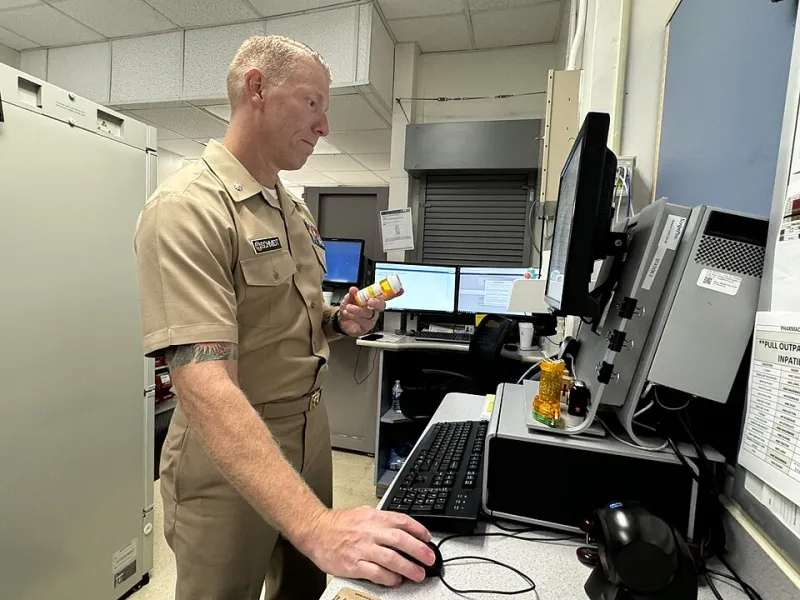
Photo: U.S. Navy NMRTC by Emily McCamy, Public domain, via Wikimedia Commons
There was a time when filling a prescription meant handing a paper slip to a pharmacist who reviewed it by hand, cross-referenced your medication history from memory or a physical file, and personally counseled you at the counter. That model has been replaced — steadily and substantially — by a network of automated systems that process millions of prescriptions each day across the United States with speed and efficiency that no human team could replicate.
Efficiency, however, is not the same as accuracy. And in the context of medication management, the distinction carries real clinical weight.
How Automation Entered the Pharmacy Workflow
Pharmacy automation was introduced with legitimate and well-documented benefits. High-volume dispensing robots reduce manual handling errors. Electronic prior authorization platforms streamline insurance approvals. Algorithmic drug interaction checkers flag potential contraindications faster than any individual pharmacist reviewing a full medication list could. These tools, when functioning correctly and supervised appropriately, have meaningfully improved pharmacy operations.
The problem emerges when automation is treated not as a support layer but as a replacement for clinical judgment. Many large retail pharmacy chains and pharmacy benefit managers now route prescriptions through multiple automated checkpoints before a licensed pharmacist ever sees them — if a pharmacist reviews them at all in any meaningful depth. Workflow pressures, staff shortages, and the sheer volume of prescriptions processed daily have created conditions in which algorithmic outputs are accepted rather than interrogated.
According to data from the National Academy for State Health Policy and various state pharmacy board reports, pharmacist workload in high-volume retail settings has increased substantially over the past decade, even as automation was ostensibly introduced to reduce that burden. The result, paradoxically, is a pharmacist who is more overwhelmed and therefore less able to catch what the algorithm misses.
The Categories of Algorithmic Error Patients May Not Know About
Understanding where automated pharmacy systems are most likely to fail requires a brief look at the specific functions they perform.
Dosage verification algorithms cross-reference prescribed doses against standard ranges in their databases. These databases are periodically updated but are not always current with evolving clinical guidelines. A dose that falls outside an algorithm's programmed range may be flagged and held — delaying a legitimate prescription — while a dose that has been recently identified as problematic in a specific population may pass through unquestioned if the system has not yet been updated.
Drug interaction checkers operate similarly. They compare a new prescription against a patient's medication profile on file at that specific pharmacy. If a patient fills prescriptions at more than one location — a common reality given insurance network restrictions and specialty pharmacy requirements — the algorithm has an incomplete picture. It may clear a combination that a pharmacist with full visibility would immediately question.
Refill recommendation systems present a different category of risk. Some pharmacy platforms now use predictive algorithms to prompt automatic refills based on historical fill patterns. These systems do not account for a patient who has recently been hospitalized, had a medication discontinued by a specialist, or changed dosages following a telehealth consultation. Patients have reported receiving refills for medications they were no longer taking — and in some cases, being billed for them.
Insurance adjudication algorithms introduce yet another layer of complexity. These systems determine in real time whether a claim will be approved, at what tier, and whether a prior authorization is required. Errors in this process can result in patients being told a medication is not covered when it is, being offered a therapeutic substitute that is not clinically appropriate for their specific condition, or experiencing delays that interrupt continuity of care.
When Errors Reach Patients: The Clinical Consequences
The downstream effects of algorithmic pharmacy errors are not always visible at the point of dispensing. A patient who receives a slightly incorrect dose may not notice an immediate change. Someone whose drug interaction was not flagged may attribute emerging symptoms to their underlying condition rather than a medication conflict. These errors are, by their nature, difficult to trace.
Reported cases documented in pharmacy board complaints and peer-reviewed literature have included instances where automated systems approved refills for discontinued controlled substances, failed to flag dangerous combinations of anticoagulants and common over-the-counter supplements that had been added to a patient's profile, and processed incorrect quantity dispensing due to a unit-of-measurement coding discrepancy that the algorithm interpreted differently than the prescribing physician intended.
In each of these scenarios, a pharmacist with adequate time and complete information might have caught the error. The algorithm, operating within its defined parameters, did not.
What Patients Can and Should Do
The appropriate response to these systemic vulnerabilities is not to distrust pharmacy systems categorically. Automation, properly supervised, remains a net positive for medication safety. The appropriate response is informed engagement — understanding that these systems exist, knowing their limitations, and exercising the right to request human review.
Request a pharmacist consultation at every fill. Federal law and most state pharmacy regulations entitle patients to pharmacist counseling when picking up a new prescription. Exercise this right. Ask the pharmacist directly whether your prescription was reviewed by a licensed professional or cleared primarily by an automated system.
Maintain your own complete medication list. Because automated drug interaction systems depend on the medication profile held at a single pharmacy, they cannot protect you from interactions involving prescriptions held elsewhere. Keeping a current, comprehensive list of every medication, supplement, and over-the-counter product you take — and sharing it with each provider and pharmacy you use — partially compensates for the system's structural blind spots.
Verify refills before accepting them. If you receive a notification that a refill has been processed automatically, confirm with your prescribing provider that the medication is still part of your active treatment plan before picking it up. This is especially important following a hospitalization, a specialist visit, or any recent change in your health status.
Ask about manual override options. If you have concerns about how your prescription was processed — whether the dosage looks different from what your provider discussed with you, or whether an insurance substitution was made without your knowledge — you are entitled to ask the pharmacist to manually review and verify the prescription. Most pharmacists will do so willingly; the challenge is that patients often do not know to ask.
Use a centralized pharmacy relationship where possible. Consolidating your prescriptions at a single pharmacy — or through an integrated care platform that maintains a unified medication record — reduces the fragmentation that automated systems cannot bridge on their own.
The Broader Accountability Question
Pharmacy automation vendors, pharmacy benefit managers, and large retail chains have a shared responsibility to ensure that the systems they deploy are current, clinically validated, and subject to meaningful human oversight. Patients, however, cannot wait for systemic reform before taking steps to protect themselves.
At RxConnect Care, we believe that technology should expand access to safe, coordinated medication management — not replace the clinical judgment that makes that management trustworthy. If you have questions about how your prescriptions are being processed, or if something about a recent fill does not match what your provider prescribed, our care team is available to review your medication history and connect you with a pharmacist who can provide the human verification that automated systems are not designed to replicate.
The algorithm is a tool. Your health requires more than that.